We know Lawrence did a good job of blowing up the Hejaz Railway, but who were the guys who actually built it?
24th July 2026
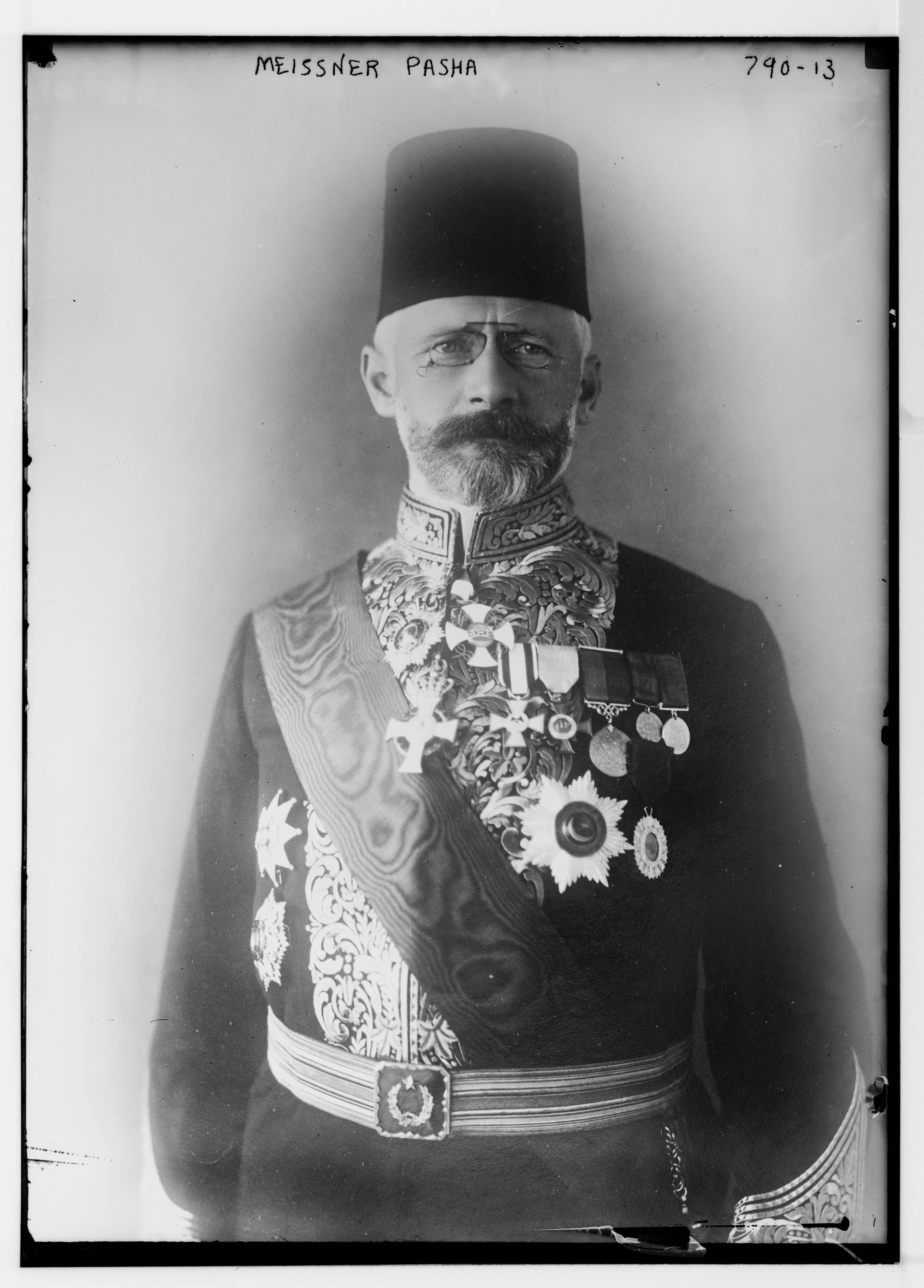
Miessner Pasha in his full Turkish finery
Although ordered by Ottoman Sultan Abdul Hamid II in 1900 and paid in part by Ottoman Empire funding and part international Islamic donation, the Hejaz Railway was the baby of a German Engineer Heinrich August Meissner, AKA (to give him his Turkish handle) Meissner Pasha. The Director of Construction was Turkish, Kazim Pasha, who managed the logistics and Ottoman troop Labour, but this was Heinrich’s project.
It is worth pointing out from the start that this was actually a humanitarian project. Previous to the line being opened, up to a huge 20% of pilgrims making the journey by other means died on the route. Be it disease, bandits, or, in the main, just the extreme heat of such a long journey, in many cases taking months on foot, this was a very perilous journey. The word Hejaz in Arabic translates as ‘The Barrier’ a very apt name for this region.
The opening of a line between Damascus and Madinah was a game changer. But this was not the main reason for its construction. For Madinah, a far-flung garrison of the Ottoman Empire, it was a literal lifeline.
Up to 5,000 Turkish soldiers provided the labour for the project, alongside local labour and specialised Engineers from all over the Empire and Europe. It had a project value of Sixteen Million US Dollars, that is an equivalent of $638 Million dollars today, a huge project some 1,320 km long. Damascus to Madinah was a 40 day camel ride, the railway cut that journey down to a matter of days.
No records were kept of fatalities during the construction between its commencement in 1900 and its completion in 1908, estimates range between several hundred, up to a thousand and many are buried where they died, in the sand close to the site of the tracks. The death rate due to many of the same reasons the pilgrims perished prior to its construction. Diseases such as Cholera and Dysentery were prevalent in the work camps. Local Bedouin tribes launched frequent attacks, upset that the railway would kill off their monopoly on the camel caravans of pilgrims and their resultant commercial loss. However, when you look at the 25,000 who died constructing the Panama Canal then even the highest estimated figure on the Hejaz Railway is small in comparison.
The Sultan originally proclaimed that he wanted 100% Ottoman production for the procurement, an impossible task on such a huge rail project. The rail itself was made in the majority in Germany, although steelworks in Belgium and America were involved in a lesser scale.
With the sleepers the Engineers originally stuck with the Sultans wishes, using Ottoman timber, however the extreme desert heat caused the timbers to shrink, warp and split, so procurement swiftly changed to importing steel sleepers for the remainder of the southern desert stretches.
For the Bridges, Stations and Barracks the solution was simple and Basalt was quarried from local hils for all of the construction.
Today, large sections of the Hejaz Railway have been repaired and in use in Jordan and Syria, in the case of Jordan a tourist attraction. In Saudi Arabia the Hejaz remains inoperable for logical reasons. It was built through unpopulated huge stretches of the western desert, it is much more remote than in Jordan. The Saudi Government, quite rightly in my opinion, have looked at the Hejaz Railway as a deliberate preservation of these historic sites, as an open-air museum rather than a working railway.
It is also worth mentioning the Canadian railway troops who did a fantastic job in Palestine and Syria in 1919 for General Allenby , including the 1st Canadian Bridging Company to repair vital rail line and bridges blown by retreating Turkish troops. Lawrence may have been good at blowing them up but the Canadians were just as good at putting them back together again.
As for Herr Meissner, he returned to Germany in 1918, however the pull of the Turkish Railway was too strong for him. In 1924 President Ataturk personally invited him to return to the newly established Republic of Turkey as his Construction and Railway consultant. Between 1924 and 1933 he oversaw the extensive repair of the Turkish railway destroyed during both WW1 and the Turkish war on independence. He died in Istanbul and is buried there. The colossal Baghdad Railway project that he had spent decades of his life working on was finally completed 2 months after his death.